
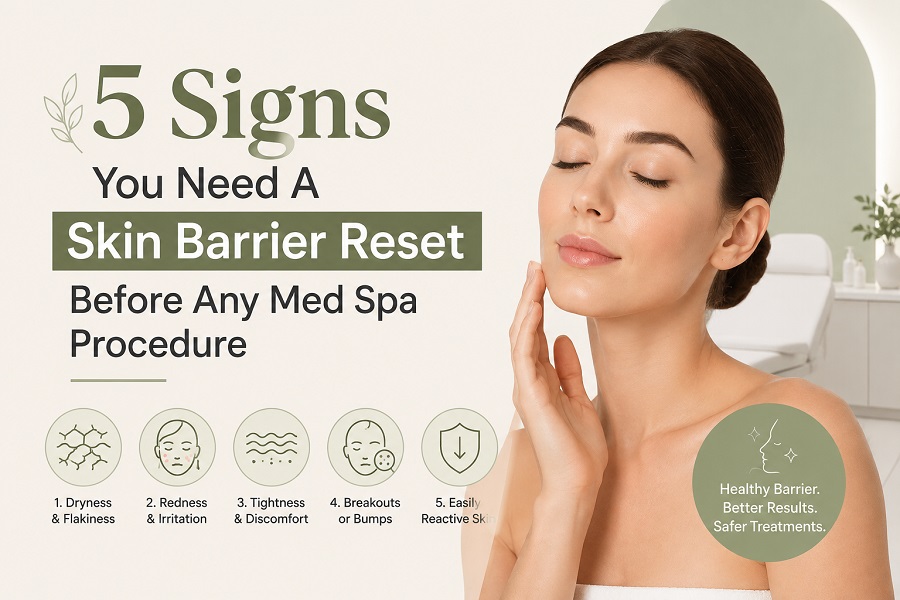
You might be excited about booking that Med Spa visit at a medical spa in Buffalo Grove, IL. A smoother peel, a brighter laser session, maybe microneedling to finally work on texture or scars. Then you catch your reflection and notice your skin feels tight, looks a bit angry, and every new product seems to sting. You start to wonder if your skin is even ready for what you are about to put it through.end
If that sounds familiar, you are not alone. Many people walk into a Med Spa focused on the “after” photos, while their skin barrier is quietly waving a red flag in the background. When the barrier is not ready, even the best treatment can feel too harsh, and recovery can be longer and more uncomfortable than it needs to be.
The short version. If your skin is stinging, flaking, reactive, or suddenly unpredictable, there is a good chance you need a skin barrier reset before your next Med Spa procedure. When you calm and strengthen the barrier first, treatments tend to feel gentler, results look smoother, and you are less likely to end up with irritation you regret.
Why does your skin barrier matter so much before Med Spa treatments?
Your skin barrier is the outer layer of your skin that keeps water in and irritants out. It is made of cells and lipids that work together like a tight brick wall. When this barrier is healthy, your skin feels comfortable, looks even, and handles treatments much more gracefully. When it is compromised, everything feels too intense.
According to dermatology research on the structure and function of the skin barrier, this outer layer plays a central role in hydration and in protecting you from chemicals, allergens, and microbes. A Med Spa treatment like a peel, laser, or microneedling puts controlled stress on the skin to trigger renewal. If the barrier is already struggling, that extra stress can tip things into burning, prolonged redness, or even breakouts.
So where does that leave you before your appointment. It starts with recognizing the signs that your skin is asking for a reset, not another active product.
Sign 1: Everything suddenly stings, even products that used to feel fine
One of the clearest signs you need a skin barrier reset before a Med Spa treatment is unexpected stinging or burning. A cleanser you have used for years now tingles. A gentle moisturizer suddenly feels spicy. Even plain water can feel tight or uncomfortable.
This often happens after stacking too many actives. Maybe you added a strong retinoid, an exfoliating toner, a vitamin C serum, and still wanted a weekly peel mask. None of these are “bad” on their own, but together they can thin the barrier and increase sensitivity.
If your skin already reacts this way at home, imagine how it might feel with a strong peel or intense laser. That is when pausing and repairing first is not just wise. It is self protection.
Sign 2: Your skin is dry, flaky, or rough no matter how much you moisturize
Another sign your barrier is not ready is persistent dryness that does not respond to your usual products. You may see:
- Flaky patches around the nose, mouth, or between the brows
- Makeup catching on tiny dry spots
- Skin that feels tight within minutes of washing
Often the problem is not that you need a “heavier” cream. It is that the barrier is not holding water properly, so moisture escapes quickly. Dermatologists who talk about keeping skin healthy and comfortable in dry conditions emphasize gentle cleansing and barrier supporting ingredients for this reason.
Now picture adding a resurfacing treatment on top of already rough, dehydrated skin. The treatment can cling to dry patches, heal unevenly, and leave you feeling more chapped than refreshed. Repairing the barrier first helps your skin hold onto moisture, so treatment results look smoother instead of patchy.
Sign 3: Redness has become your “new normal”
Maybe your cheeks flush easily, or there is a constant pinkness across your face that was not there a year ago. You might notice that your skin stays red long after washing or applying skincare. This low level inflammation is a signal that your barrier is on edge.
Med Spa procedures often cause temporary redness as part of the healing process. If you are already starting from a baseline of irritation, that temporary redness can last longer and feel more intense. In some cases, it can even trigger flare ups of conditions like rosacea.
Calming the barrier ahead of time gives your skin a better “starting point” so that post treatment redness fades more predictably.
Sign 4: Breakouts, bumps, or rashes appear out of nowhere
When the barrier is weakened, it is easier for irritants and bacteria to disrupt the skin. That can show up as breakouts in new areas, tiny itchy bumps, or rash like patches that feel sore or hot to the touch.
Many people respond by throwing more actives at the problem. Stronger acids. Harsher spot treatments. More frequent masks. This can create a cycle where the skin never has a chance to recover.
Trying to “fix” these flare ups with an aggressive treatment like a deep peel can backfire. You might end up with more inflammation instead of the clear, calm skin you were hoping for. A short period of barrier repair, often just a few weeks, can break this cycle and set you up for better Med Spa results.
Sign 5: Your usual mask or treatment feels harsher than it used to
Maybe you have a favorite at home mask you have always tolerated. Lately, it tingles more. Your skin looks extra flushed after rinsing. Or your retinoid, which used to be easy, now leaves you peeling and sore for days.
This change in tolerance is your skin telling you something. The barrier that once buffered these products is thinner and more fragile. Even professional organizations that discuss safe use of facial masks and skincare emphasize listening to early signs of irritation and adjusting your routine.
If your skin is struggling with at home products, it is not ready for stronger in office versions. Respecting that limit is not “losing time.” It is protecting your future results.
How does a barrier reset compare to pushing ahead with treatment anyway?
You might be wondering if it is worth delaying a Med Spa appointment to focus on barrier repair. The comparison below can help you weigh that choice.
| Approach | Short Term Experience | Recovery Time | Results Quality | Common Risks |
| Proceed with treatment on a compromised barrier | More stinging or burning during and after treatment | Often longer. Redness and dryness can linger | Can look patchy or uneven. Texture may feel rougher at first | Increased irritation, post inflammatory hyperpigmentation, flare ups of sensitivity |
| Reset and strengthen barrier before treatment | Skin feels calmer. Treatment discomfort is usually easier to manage | Often shorter. Redness and dryness resolve more smoothly | Results tend to look smoother, more even, and more “polished” | Lower risk of prolonged irritation and rebound sensitivity |
When you look at it this way, a short pause to restore your barrier is less of a delay and more of an investment in the results you are paying for.
What can you do right now to prepare your skin for Med Spa procedures?
If you are noticing two or more of these signs, your skin is asking for a reset. You do not have to overhaul everything. A few focused changes can make a real difference before your appointment.
1. Simplify your routine for at least 2 to 4 weeks
Pull back to the basics. Gentle cleanser. Hydrating serum or toner if your skin likes it. Barrier focused moisturizer. Daily sunscreen. Put strong acids, scrubs, and extra peels on pause. Many people are surprised how quickly their skin calms down once the “noise” is removed.
This quiet period gives your barrier space to rebuild. Think of it as training your skin so it can handle the intensity of professional procedures without feeling overwhelmed.
2. Focus on ingredients that support repair
Look for products that include barrier friendly ingredients like ceramides, glycerin, hyaluronic acid, and soothing agents such as niacinamide or centella asiatica. These do not need to be fancy. Consistency matters more than complexity.
Use lukewarm water instead of hot. Pat your skin dry instead of rubbing. Apply moisturizer while your skin is still slightly damp to lock in hydration. Small habits like these reduce daily wear on the barrier so your Med Spa treatment can be the only “controlled stress” your skin has to handle.
3. Have an honest pre treatment conversation with your provider
Before any procedure, share what your skin has been doing lately. Mention recent stinging, new redness, or changes in how your products feel. A good provider will adjust strength, type of treatment, or timing based on your skin’s current state.
You can ask directly. “My skin has been more sensitive. Can we focus on a gentler option first and build up over time.” This kind of conversation is a sign you are taking your skin health seriously, not that you are being difficult.
Giving your skin the respect it deserves before Med Spa treatments
A skin barrier repair before Med Spa services is not about perfection. It is about giving your skin the support it needs so your treatments work with it, not against it. When your barrier is calm and strong, peels are more even, lasers heal more gracefully, and your reflection looks more like the outcome you hoped for instead of a surprise detour.
The signs are usually there long before a bad reaction. Stinging where there used to be comfort. Dryness that will not quit. Redness that lingers. New bumps that do not match your usual pattern. A favorite mask that suddenly feels too strong. Paying attention to these early signals is one of the kindest things you can do for your skin.
You do not need to chase every treatment at once. Start by listening. Simplify. Repair. Then choose Med Spa procedures that match where your skin is today, not where you wish it were. Your skin will tell you when it is ready, and when it is, the results often speak for themselves.